Arcadia is a tooled method devoted to systems & architecture engineering, supported by Capella modelling tool.
It describes the detailed reasoning to
It can be applied to complex systems, equipment, software or hardware architecture definition, especially those dealing with strong constraints to be reconciled (cost, performance, safety, security, reuse, consumption, weight…).
It is intended to be used by most stakeholders in system/product/software or hardware definition and IVVQ as their common engineering reference and collaboration support.
Arcadia stands for ARChitecture Analysis and Design Integrated Approach.
A series of online documents to dive into the principles and concepts of Arcadia:
Arcadia is a system engineering method based on the use of models, with a focus on the collaborative definition, evaluation and exploitation of its architecture.
This book describes the fundamentals of the method and its contribution to engineering issues such as requirements management, product line, system supervision, and integration, verification and validation (IVV). It provides a reference for the modeling language defined by Arcadia.
Jean-Luc Voirin, leader of the creation of the Arcadia method, along with some of the leaders on developing and deploying MBSE Arcadia & Capella practices in Thales. From right to left: Pierre Nowodzienski, Jean-Luc Voirin, Juan Navas, Stephane Bonnet, Frederic Maraux, Gerald Garcia, Philippe Fournies, Eric Lepicier.
Architecture as prime engineering driver
Arcadia, a model-based engineering method
Noticeable features of Arcadia
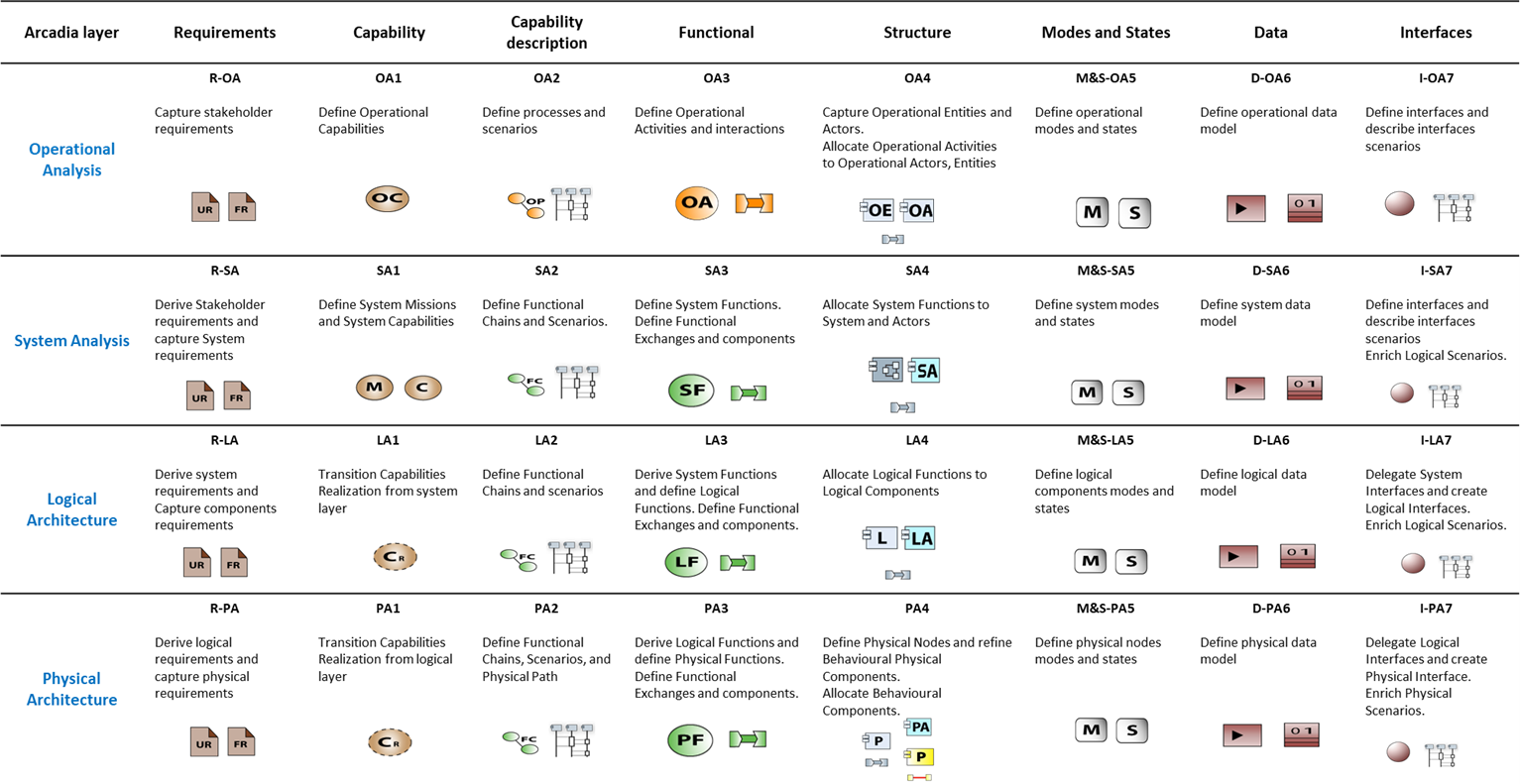
Definition of the Problem - Customer Operational Need Analysis
Formalization of system requirements - System Need Analysis
Development of System Architectural Design - Logical Architecture (Notional Solution)
Development of System Architecture - Physical Architecture
Formalize Components Requirements - Contracts for Development and IVVQ
Co-Engineering, Sub-Contracting and Multi-Level Engineering
Adaptation of Arcadia to Dedicated Domains, Contexts, Etc.
Equivalences and Differences between SysML and Arcadia/Capella
If you're looking to create a guide for "anewayanmamajunyuuchuu," consider the following steps:
As she ventured into the forest, Akira stumbled upon a hidden clearing. In the center of the clearing stood an ancient tree, its trunk glowing with a soft, ethereal light. Akira felt drawn to the tree, as if it was calling to her. She approached the tree and discovered a small, delicate flower blooming at its base. The flower's petals shimmered with a light that seemed almost otherworldly. anewayanmamajunyuuchuu
The subject matter touches upon a specific Japanese subculture known as . If you're looking to create a guide for
At first glance, this sequence appears to be a random mashup of syllables—perhaps a typo, a code, or a forgotten password. However, a closer linguistic and cultural examination reveals a more fascinating story. This article aims to decode the possible origins, meanings, and implications of "anewayanmamajunyuuchuu," exploring its relevance in the context of digital communication, language evolution, and online subcultures. She approached the tree and discovered a small,
In Japan, the relationship between a mother and child is highly valued, and prenatal care is taken seriously. The term "anewayanmamajunyuuchuu" might be an example of this cultural emphasis, highlighting the importance of nurturing and caring for the mother and child during pregnancy and beyond.
This doesn't match any known public figure, cultural term, or media title in Japanese, English, or other major languages. It might be: